
Marketing teams live in multi-step, multi-tool work: pulling campaign data, analyzing it, drafting content, formatting it, and distributing across many channels. Claude Cowork for marketing teams brings in an AI agent that actually does the work rather than just answering questions, taking those tasks through to finished, ready-to-use deliverables. This guide explains how Claude Cowork helps marketing work, why marketing teams benefit fastest, with real examples from Anthropic's own teams, and six use cases Thai marketing teams can adapt right away.
What Cowork is, from a marketer's point of view
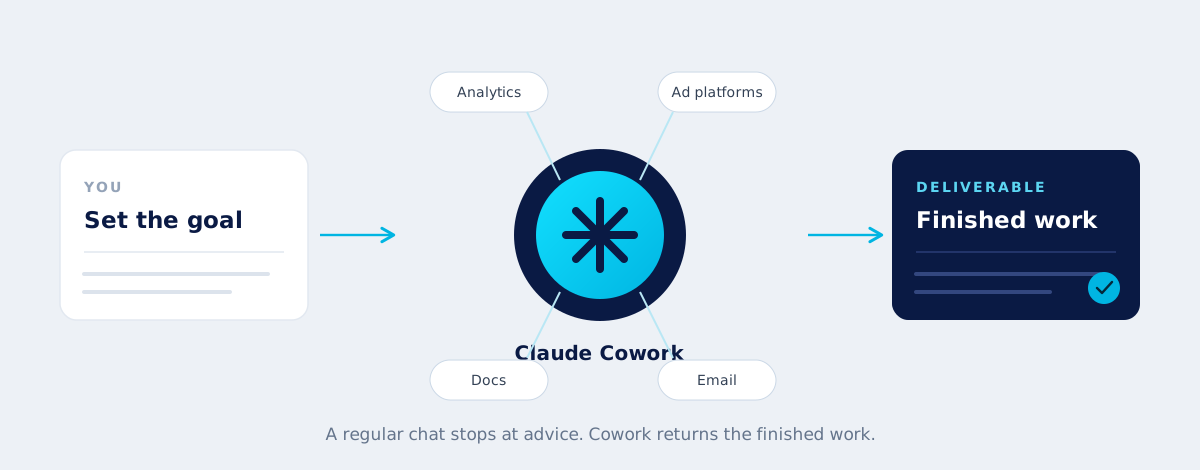
Claude Cowork is Anthropic's agentic AI system for knowledge work that runs on the Claude desktop app. The key difference is that it does not stop at replying with text - it carries out multi-step work across your files, folders, and connected apps to return finished work. Its idea is "from delegation to deliverables." If you want the big picture of the tool first, read what Claude Cowork is.
For marketers, think of the difference this way. A regular AI chat is like an advisor that tells you how to do something, and you still have to copy, format, and assemble the work yourself. Claude Cowork is like an assistant that takes the brief and does the actual work until there is a deliverable. Instead of getting advice on "how to summarize a campaign," you get the campaign report itself, with the data already pulled and formatted. This is the heart of Agentic AI, where AI plans and acts to reach a goal.
Why marketing teams benefit fastest
Of all the departments in an organization, marketing often sees results from Claude Cowork quickly, because the nature of the work fits what an AI agent does well:
- Work is step-by-step and repeats on a cycle. Weekly reports, campaign setup, and regular content all have clear, repeatable steps, which is exactly what an agent is good at handling.
- It spans many tools. A single marketing task often crosses analytics, ad platforms, a content management system, email, and social. Cowork working across connected apps reduces the constant switching between screens.
- Frequent deadlines, high volume. Marketing has to produce and distribute content continuously, so handing time-consuming work to AI returns time to the team for strategy and creativity.
- No coding required. Cowork is built for non-technical people, so marketers can direct it in plain language with no technical-skill barrier.
Together, that is why marketing is often one of the first teams to see concrete benefits from putting AI agents to work.
Real examples from Anthropic's own marketing teams
Anthropic, the maker of Claude, has published how its own marketing teams use Claude and Claude Cowork on the claude.com blog. The figures below are results Anthropic's internal teams reported, cited with their sources to illustrate the potential (actual results will vary by each organization's context):
Marketing Operations with Claude Cowork
In the post about the marketing operations team's use of Claude Cowork (published July 8, 2026), Anthropic describes two main workflows:
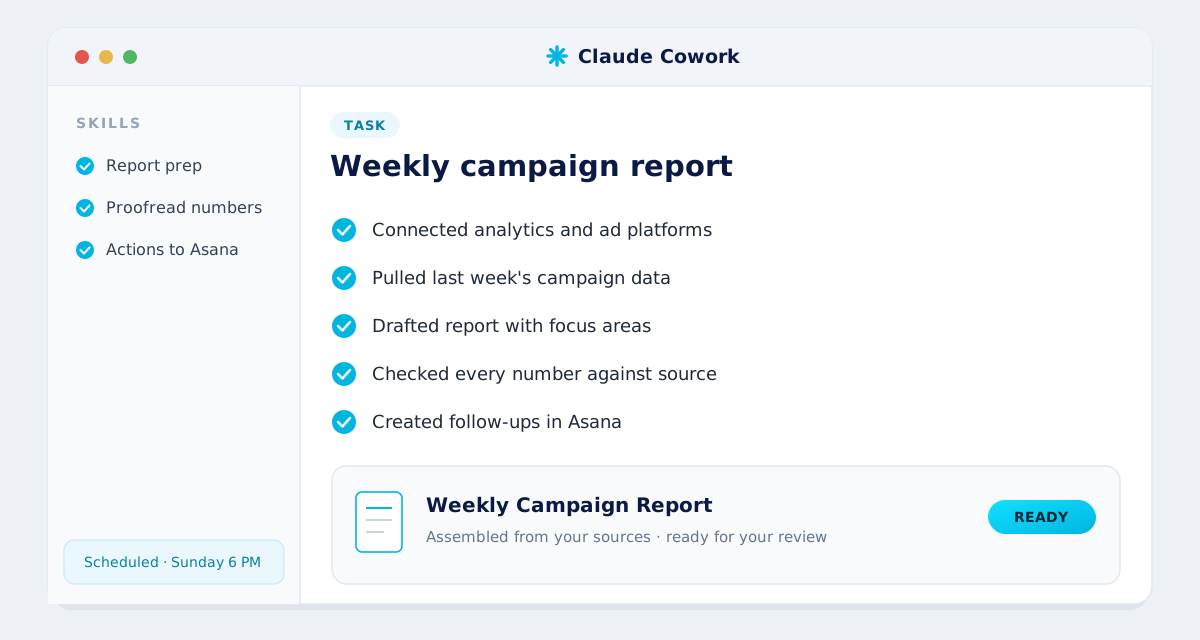
- Weekly marketing reporting (Ian Chan): a scheduled task runs on Sunday evening, reads the previous week's review, meeting transcripts, and Slack messages, then queries the data warehouse to produce an initial report with metrics tables. It uses three skills: a prep skill that assembles the report, a proofreading skill that checks "every number" against a verified source, and an action-items skill that turns follow-ups into Asana tasks. The result: work that used to take "up to two days" now takes "up to two hours."
- Campaign and event setup (Annabel Custer): requests come in via Slack, a dispatcher skill reads and routes them hourly, then five specialist skills connect to Salesforce, HubSpot, and Swoogo, with an audit agent - a separate Claude instance - testing registrations before approval. This compressed work that used to take "days" into "hours."
Other Anthropic marketing teams
Another post on how Anthropic's marketing teams use Claude (published January 26, 2026) lists the figures each team reported:
- Growth marketing: Austin Lau cut ad creation time from 30 minutes to 30 seconds, and built a Figma plugin himself in about 45 minutes to an hour, which saves nearly 30 minutes every time creatives are updated across multiple aspect ratios.
- Influencer marketing: using Claude to write scripts for influencers and podcasts freed up more than 100 hours per month for higher-value work.
- Customer marketing: reduced case study drafting from 2.5 hours to 30 minutes, saving about 10 hours per week.
- Digital marketing: built workflows that increased team productivity by 5x year over year.
- Product marketing: uses Skills and Projects to create launch briefs, saving 5 to 10 hours per launch.
- Partner marketing: built self-serve event enablement for the sales team, reducing trade show prep time by 40 percent.
What is worth noting is that these figures did not come from simply chatting with AI - they came from setting up workflows where AI does multi-step work across tools, the same approach Claude Cowork opens up to non-technical marketers.
Six use cases for Thai marketing teams
Building on the above, here are six use cases Thai marketing teams can adapt with Claude Cowork (example workflows offered as guidance - design and test them to fit your own organization's data and tools):
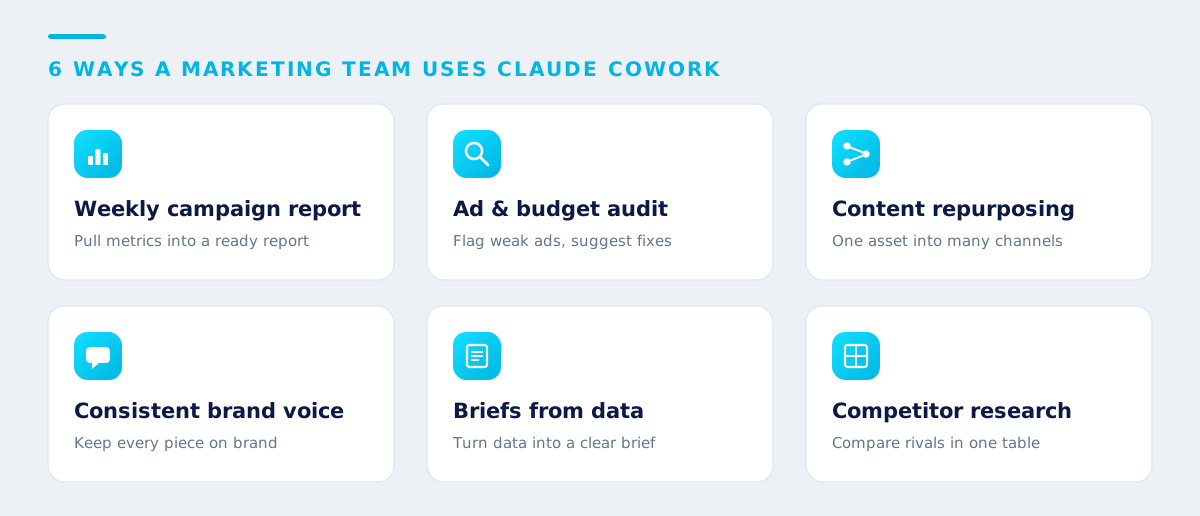
- Automated weekly campaign reporting. Have Cowork pull numbers from your connected analytics and ad platforms, assemble a summary report with highlighted focus areas, then let a human review it before it goes into the meeting - much like Anthropic's weekly reporting workflow.
- Ad and budget audits. Have it review ad sets, creatives, and spend against your KPIs, flag underperformers, and propose what to pause or reallocate, producing a checklist for the team to decide on.
- Repurpose one piece of content into many channels. From a single article or webinar recording, turn it into a Facebook post, a LINE message, a LinkedIn post, an email, and a short-video script, in your brand's format and tone. Build on the ideas in Generative AI for marketing.
- Keep a consistent brand voice. Maintain a reference set of your brand's tone and terminology for Cowork to use when it checks and adjusts writing to a consistent style across every piece. Good briefs and references are the key - see how to frame them in Prompt Engineering for business.
- Build briefs from data. From a customer data file or market research, distill a campaign brief or creative brief with the target audience, key messages, and content direction for the team to build on.
- Competitor and market research. Have it gather competitors' content, positioning, and promotions from multiple sources into an easy-to-read comparison table, to find gaps and opportunities for your brand.
Every use case should start with non-sensitive data and always keep a human review point before the output is used for real.
How to start safely and see results
The approach that works is to start small, measure, then scale:
- Pick a repetitive, low-risk pilot task such as weekly campaign reporting or content repurposing.
- Connect only the tools and data you need, following least privilege - do not open access to everything at the start.
- Write clear briefs and make them into reusable instructions. The clearer the brief, the more accurate and easier-to-review the output.
- Set a human review point before publishing, especially for anything public-facing.
- Measure the time saved and the quality before expanding to other teams or tasks.
Intelevo offers training on using Claude and Claude Cowork for marketing teams and organizations, from choosing pilot workflows and writing briefs and instructions to setting up governance. Learn more at our in-house AI training service.
Cautions for marketing work
Because marketing work is public-facing and touches customer data, take extra care:
- Data and PDPA. Do not feed in personal data or sensitive customer data unnecessarily. Use only approved data and set clear boundaries. Read more in AI governance and data security.
- Accuracy of numbers and citations. Do not publish statistics or claims that have not been verified. A good workflow includes a step that checks every number against a verified source, like Anthropic's proofreading skill.
- Brand safety and copyright. Content that AI helps draft must be checked for brand fit, no copyright infringement, and no overstated claims before it is used.
- People remain accountable. Keep a human in the loop to review and approve every piece before it is published. AI speeds up the work, but the decisions and the responsibility still belong to the team.
Conclusion
Claude Cowork for marketing teams brings agentic AI that actually does the work to the multi-step tasks of marketers - from reporting and ad audits to multi-channel content and competitor research - with no coding required. Anthropic's own marketing teams have shown that setting up workflows like this can cut task time significantly, but the key is to start with low-risk work, keep data and brand safety tight, and always have a human review before publishing. Organizations that start systematically and measure real results will capture the value of Claude Cowork fastest and most safely.
If your marketing team wants to start using Claude Cowork the right way, the Intelevo team can design the workflows and train your team to use it for real. See our approach and the team behind it on the team and founder page.
Key takeaways
- Claude Cowork lets AI run multi-step marketing work across files and tools to a ready-to-use deliverable, not just answer questions like a chat.
- Marketing benefits fastest because the work is step-by-step and repetitive, spans many tools, has frequent deadlines, and needs no coding.
- Anthropic's own teams reported real results, such as weekly reporting from up to 2 days to about 2 hours, case study drafting from 2.5 hours to 30 minutes, and ad creation from 30 minutes to 30 seconds (source: claude.com).
- Six adaptable use cases: campaign reporting, ad audits, content repurposing, brand voice, briefs from data, and competitor research.
- Start with low-risk work, protect PDPA and brand safety, verify every number, and always keep a human review before publishing.
Frequently asked questions
How is Claude Cowork different from a regular AI chat for marketing work
A regular AI chat replies with text, and marketers still have to format it, pull files together, and do the work themselves. Claude Cowork carries out multi-step work across your files and connected apps to return a ready-to-use deliverable, such as a campaign report or a multi-channel content set, not just advice. You set the goal and it returns the finished work.
Do marketers need to know how to code to use Claude Cowork
No. Claude Cowork is designed for non-technical knowledge workers. You direct it in plain language, like briefing a teammate, with no coding and no terminal required. What matters more is briefing it clearly and reviewing the output before you publish.
Which task should a marketing team start with when using Claude Cowork
Start with a repetitive, time-consuming, low-risk task, such as summarizing weekly campaign results or repurposing one piece of content into several channels, using non-sensitive data. Add a human review point before publishing, measure the time actually saved, then expand to more complex work.
Enterprise AI insights, a few emails per month. No spam, unsubscribe anytime.
Related articles
Want your marketing team to use Claude Cowork effectively and safely?
Talk to the Intelevo team to plan how your marketing team adopts Claude Cowork, with team training and a governance framework. The initial consultation is free, and our team responds within one business day.
Start a consultation
An AI Transformation advisor and trainer, author of a book on using AI in marketing, and a guest lecturer at leading universities - having trained more than 5,000 executives and corporate staff.
View full profile